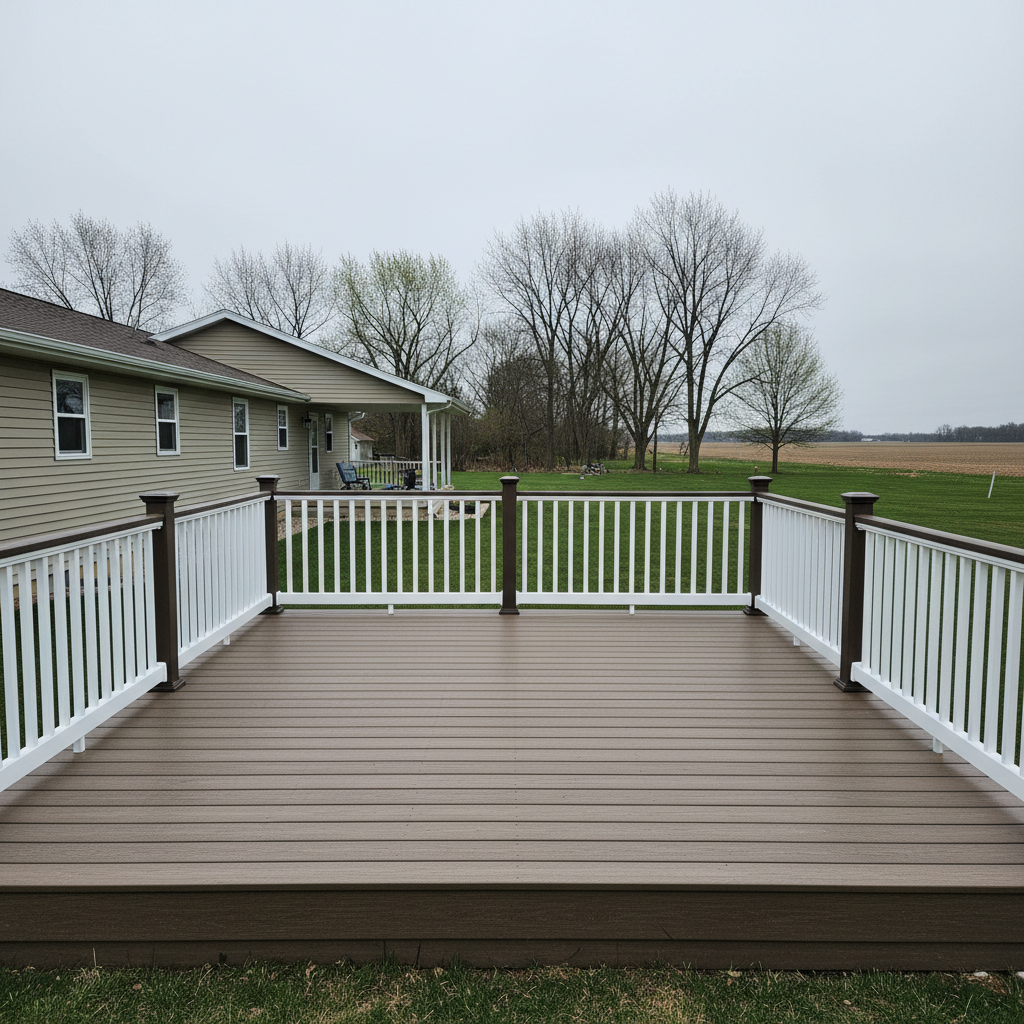
Anybody with a circular saw and a trailer can call themselves a deck builder. Most of what separates a deck that lasts twenty years from one that's wobbling by year six happens below the surface, in places you won't think to check once the boards are down. Here's what actually matters when you're vetting someone to build or fix a deck in this area.
Ask about footing depth before you ask about anything else
Dane County soil is mostly clay, and clay heaves when it freezes. The frost line here runs around 42 to 48 inches depending on where you are in the county, which is why footings need to go down at least that far, past the frost zone, into soil that doesn't move. A builder who pours a quick 18-inch footing to save a day of digging is setting you up for a deck that lifts a little every winter and settles unevenly every spring. Ask how deep the footings will go and what they're basing that number on. If the answer is vague, that's your answer.Sonotube diameter matters too. A 10 or 12-inch tube is standard for most residential deck posts, but a bigger deck carrying a hot tub or a second-story load needs wider footings and probably more of them. Anyone who hasn't run the numbers on your specific deck size and use is guessing.
Permits aren't optional, and skipping them costs you later
In Madison and most surrounding municipalities, a deck attached to the house or raised more than a couple feet off grade needs a building permit, and that typically means a footing inspection before the concrete gets poured and a framing inspection before the decking goes on. A contractor who tells you permits are a waste of time, or who says they'll just "take care of it" without pulling one, is either planning to skip the inspection or doesn't know the process. Either way, that's a problem you inherit when you go to sell the house and the deck isn't on record.If your lot backs up to a setback line or you're near a lake lot with shoreland zoning, that adds another layer most builders in other parts of the state never deal with. Ask directly whether your property needs a setback check, and don't take "probably fine" as an answer.
What they build with, and why it matters in this climate
Pressure-treated southern yellow pine is still the most common deck frame material here, and it's a fine choice for joists and beams if it's rated for ground contact where it needs to be. The decking surface itself is where people get it wrong. Untreated or poorly sealed lumber will cup and check after a couple of Madison summers, because July and August humidity swells the wood and the dry cold of January pulls the moisture back out fast. That cycle is what splits boards.Composite decking sidesteps a lot of that, but it's not maintenance-free, and a good builder will tell you that instead of letting the marketing do the talking. It still needs proper joist spacing, usually 12 inches on center instead of the 16 inches you'd use under wood, because composite sags more between supports. A contractor quoting composite decking on 16-inch joist spacing either doesn't know the manufacturer's specs or isn't planning to follow them.
Ledger board attachment is the other place corners get cut. The ledger is what ties the deck to your house, and it needs to be through-bolted or lagged into the house rim joist, flashed properly so water doesn't run behind it into your foundation wall. A deck that pulls away from the house in a storm almost always failed at the ledger, not out in the field of the frame.
What to walk away from
- A quote with no mention of footing depth or post spacing, just a square footage price.
- Anyone who tells you a permit isn't needed for an attached deck over a few feet high.
- A bid that's dramatically lower than two or three others for the same scope. Someone's cutting lumber grade, footing depth, or fasteners to hit that number.
- No mention of flashing at the ledger board at all.
- A contractor who can't tell you how they're handling drainage and grading around the posts, especially on a lot with clay soil that already drains slowly.
On older streets around Dudgeon-Monroe, Vilas, or Williamson-Marquette, you're often dealing with houses built in the 1920s through 1950s, where an existing deck or porch addition may be sitting on old concrete piers that were never inspected to current code. A repair or resurfacing job on one of these needs someone willing to dig down and actually look at what's there, not just build over it. In newer subdivisions out in Fitchburg, Sun Prairie, or Verona, the ground is more consistent and the lots are often better graded, but a lot of those neighborhoods have HOA rules on decking material, color, and even railing style. A builder who's worked in that subdivision before will know to check the covenant before ordering material, not after.
Questions worth asking on the phone before you ever get a quote
How deep will the footings go, and why. Is the ledger through-bolted or lagged, and how is it flashed. Will they pull a permit, and do they handle the inspections or leave that to you. What's the joist spacing for the decking material you're choosing. How long before you can walk on new concrete footings, and how long before the whole structure can be loaded, which is usually a matter of a few days for footing cure but longer if temperatures are near freezing when they pour. A contractor who answers these without hesitation has done this before. One who talks about finish and color before any of this has come up probably hasn't thought past the parts you can see.
A deck is one of the few home projects that's sitting outside in direct freeze-thaw cycles for five months of the year, carrying furniture, grills, and foot traffic the rest of the time. The part worth paying for isn't the boards on top, it's the work nobody sees once it's built. If you want to talk through footing depth, lumber choice, or what a repair versus a full rebuild looks like for your specific deck, our deck builder work covers all of it, from framing repairs to full custom builds.